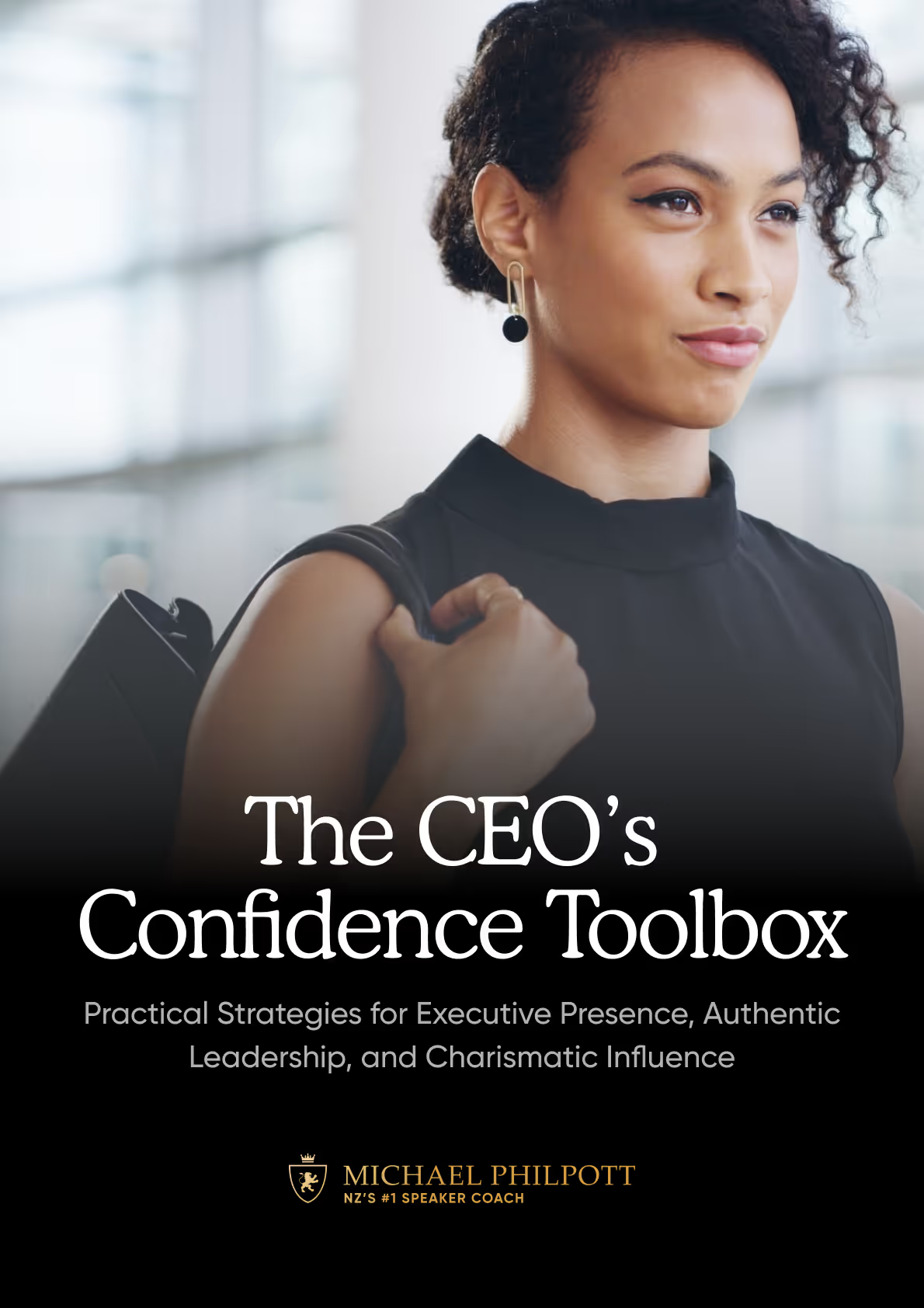
Some people walk into a room and own it.
They haven’t even said a word... but everyone pays attention.
We call it charisma.
And for a long time, we believed you were either born with it… or you weren’t.
We were wrong.
The Truth About Charisma
The idea that charisma is some mystical, unteachable “it factor” has been debunked.
It’s not a personality type.
It’s not about being extroverted.
And it’s not about “faking confidence.”
According to a landmark study by John Antonakis, Marika Fenley, and Sue Liechti (University of Lausanne), charisma is a skill. And like any skill, it can be learned.
Their research, published in the Harvard Business Review, found that:
🔹 Leaders trained in specific communication behaviours were rated as significantly more charismatic by their teams...
🔹 And those same teams showed improved performance, motivation, and trust.
The key lies in what Antonakis called the 12 Charismatic Leadership Tactics (CLTs) - a set of repeatable verbal and nonverbal behaviours that trigger deeper connection, emotion, and belief.
So What Are the 12 CLTs?
Antonakis’ team broke charisma down into 9 verbal tactics and 3 nonverbal tactics.
Verbal:
- Metaphors, similes, and analogies
- Stories and anecdotes
- Contrasts
- Rhetorical questions
- Three-part lists
- Expressions of moral conviction
- Reflections of the group’s sentiment
- Setting high goals
- Conveying confidence in the audience’s ability
Nonverbal:
- Animated voice
- Facial expressions
- Gestures
These are the behaviours that create presence, magnetism, and emotional impact... not the “natural” charm people assume you need to be charismatic.
And here’s the kicker: even one or two of these tactics can radically increase how charismatic someone is perceived to be.
From Research to Real Life: What I See in the Coaching Room
I’ve worked with everyone from CEOs to first-time speakers.
And I’ve seen what happens when people use these tactics, consciously and unconsciously.
✅ A former Olympic athlete used metaphor and storytelling to anchor her leadership message in personal legacy.
Result: she lit up the room with emotional authority.
✅ A quiet project manager learned how to use contrasts and rhetorical questions to command attention in meetings.
Result: he stopped being overlooked, and started being promoted.
✅ A senior executive shifted from monotone delivery to animated voice and three-part lists.
Result: His board presentations became memorable, not forgettable.
Why It Works: The Neuroscience of Charisma
These tactics aren’t just style, they’re strategy.
Here’s why they work:
- Stories & metaphors trigger mirror neurons - our brain’s way of emotionally simulating what others feel.
- Contrast and lists simplify complexity and engage cognitive bias for pattern recognition.
- Animated voice and gestures activate emotional circuits and increase retention.
Charisma isn’t fluff.
It’s hardwired into how humans connect, decide, and follow.
Why Most People Struggle With Charisma
Most people don’t lack charisma - they just haven’t trained it.
They’re stuck in:
- Jargon-heavy delivery
- Flat voice, flat face, flat hands
- Fear of being “too much”
They think charisma means “being impressive.”
But in reality, it means being expressive - on purpose.
And that’s something anyone can learn.
The Real Takeaway
You don’t need to “be someone else” to be charismatic.
You just need to understand the tools.
Learn how to apply them with authenticity.
And practise turning up the dial when the moment matters.
Because charisma isn’t magic.
It’s method.
And it’s teachable.