A conference keynote reminded me of something I had known all along.
Material wasn't the problem. Marketing was.
Or at least, that was the first conclusion I came to.
For months I had found myself asking the same question many business owners eventually ask.
How do I get more people through the front door?
It was not that business was bad. Far from it. I was coaching CEOs, running workshops, building online learning, writing articles, creating assessments and developing new programs.
The work itself had never been stronger.
But I wanted something different for the next chapter of the business.
Fewer hours trading time for money. More opportunities to work with groups. More people moving through workshops and online learning. More leverage. More reach. More impact.
So, like many business owners, my mind naturally drifted towards marketing.
Should I invest more in Facebook advertising? Should I pour money into Google? Should I create another lead magnet? Should I redesign the website? Should I write more articles? Should I make another video? Should I create more?
That was the trap.
I kept looking at what else I could build, when the real issue was not the absence of material.
The real issue was that not enough people were experiencing the material I had already built.
Then something happened that completely changed the way I think about growing a business.
Ironically, it was not something new.
It was something I had forgotten.
We teach that which we most need to learn
I often tell people that one of the great ironies of life is that we usually teach the lessons we still need to keep learning ourselves.
This was one of those moments.
Looking back now, I think I had become a little bit of a hobbit.
Not because I did not love people. Not because I did not love speaking. Not because I had stopped caring about the work.
I was simply tired.
Anyone who has built a business knows the feeling. There are seasons where you are constantly creating, refining, serving, improving and pushing. You build the workshop. Then you improve the workshop. Then you write the article. Then you create the assessment. Then you reply to the emails. Then you deliver the coaching. Then you prepare the next proposal. Then you wonder why you feel exhausted by the thought of promoting any of it.
Slowly, without noticing, you step out of the spotlight.
You tell yourself that the work is good enough to be found.
You tell yourself people will eventually discover it.
You tell yourself you are just focusing on quality.
But sometimes what we call quality is actually hiding.
That was uncomfortable to admit because I coach people for a living on visibility.
I help leaders communicate with clarity. I encourage people to stand in front of rooms, tell better stories, use their voice and take up space. I help people stop burying their ideas under corporate language and start communicating like human beings.
Yet somewhere along the way, I had quietly become less visible myself.
The irony was not lost on me.
A conversation I never forgot
Many years ago I was sitting in a cafe in Christchurch with one of my mentors, Dr Rich Allen.
If you have ever met Rich, you will know he is impossible to forget.
He is a six-foot-something Texan with an unmistakable accent, the sort of person who fills a room before he even starts speaking. More often than not, he would be wearing one of his trademark short-sleeved Hawaiian shirts, which somehow made complete sense the moment you met him.
Rich had originally been both a mathematics teacher and a drama teacher.
An unusual combination.
But somewhere along the way, he realised something fascinating. When you combine the structure of mathematics with the engagement of drama, people remember more.
Logic gives ideas shape.
Performance gives them life.
That became part of the foundation of his work.
Over coffee that day, he shared something that seemed almost too simple. He told me he could usually tell how healthy his entire business was by looking at one thing.
His stage time.
If he was speaking regularly, everything else grew. Workshop enquiries increased. Consulting increased. Coaching increased. Corporate opportunities appeared. Conversations opened that would never have opened otherwise.
If keynote bookings slowed down, everything else slowed down too.
At the time, I remember thinking how obvious it sounded.
Of course.
Speaking creates visibility. Visibility creates trust. Trust creates opportunity.
I understood it completely.
Intellectually.
The trouble is that knowing and doing are two very different things.
Seven hundred and fifty people reminded me
"People cannot value expertise they do not know exists."
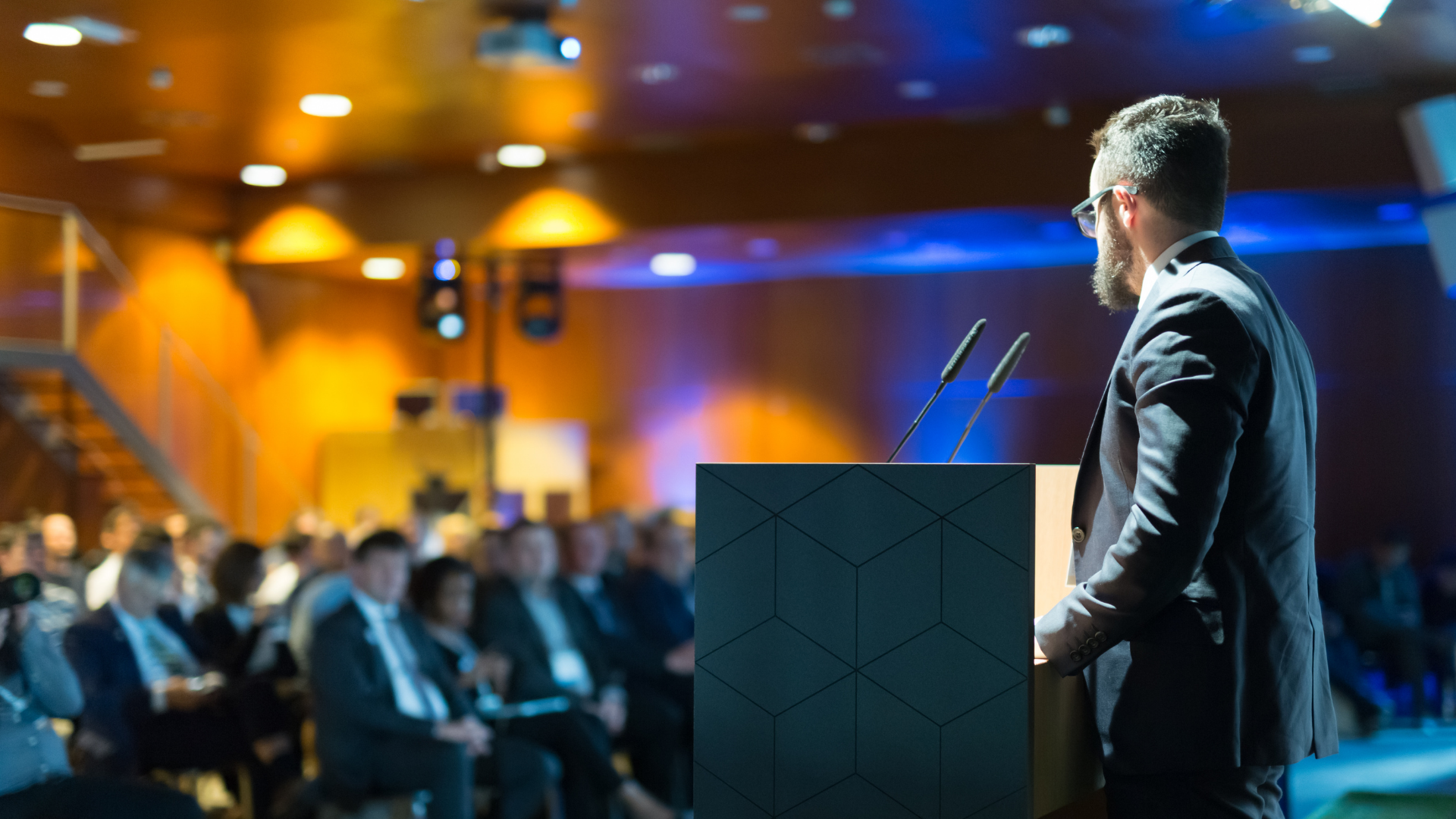
A few weeks ago, I stood in front of more than seven hundred and fifty real estate professionals to deliver a thirty-minute keynote.
I arrived early.
Partly because I wanted to settle in. Mostly because I genuinely enjoy sitting in conferences and learning from other speakers. I do not often get the chance to simply be in the audience, so I took it.
I wandered through the venue with a coffee in hand, listening to conversations, watching people reconnect with colleagues and observing the rhythm of the day.
I was just another person in the room.
Nobody looked twice
Nobody should have.
They did not know who I was.
Then, just after lunch, I walked onto the stage.
Thirty minutes later, I walked off.
As usually happens after a keynote, someone met me at the stairs. The clicker was taken from my hand. The headset microphone came off. The little Brittany-style stage mic that had been attached to my face was removed, and I was whisked away to another room for a post-event interview.
There was not much time to think.
While the final speaker before the afternoon break took the stage, I sat down with Ilse Wolfe to record a short interview about the presentation and continue the conversation we had just started with the audience.
It was actually the perfect time to do it. You are still hot from the stage. The ideas are alive. Your energy is still up. You have not had time to overthink anything.
When the interview finished, I thanked Ilse, walked out of the room and headed back towards the conference foyer.
The afternoon session had just broken.
Hundreds of people were walking towards me.
Exactly the same people I had been walking amongst that morning.
Only this time, something was different.
There is a look people give you.
You know it.
At first they are simply looking in your direction. Then, almost visibly, you can see the moment their brain connects the dots. Their eyebrows lift. Their face softens.
Oh.
I know you.
That look happened over and over again.
People smiled. They stopped me. They thanked me. They asked questions. They wanted to connect.
Great presentation.
I loved that story.
My wife thought your talk was brilliant.
Can I ask you something?
Can we talk about coaching?
It was such a simple moment, but it stayed with me.
Nothing about me had changed.
I had not become more experienced in the previous thirty minutes. I had not become a better coach. I had not built a better workshop. I had not written another article. I had not suddenly created a new product.
The only thing that had changed was that people had experienced me.
And that was the missing piece.
People cannot value expertise they do not know exists.
You can build the greatest programme in your industry. You can spend years refining your craft. You can obsess over quality. You can care more than anyone else cares.
But if people never experience your work, they will never know what they are missing.
That was when Rich Allen's words came flooding back.
He had been right all along.
Not because speaking sells.
Because speaking lets people experience your value before you ever ask them to buy anything.
And those are two completely different things.
The evidence arrived quickly
Within hours, the ripple effects began.
People completed my Speaker Assessment.
New names appeared on my email list.
People registered for my public StorySelling workshop.
Consultation calls landed in my calendar.
A podcast invitation arrived.
Even people who had shared the stage with me reached out asking if I could help them with their own presentations.
None of my services had changed.
The coaching was the same coaching.
The workshop was the same workshop.
The online learning platform was the same platform.
The articles, assessments and resources already existed.
Only one thing had changed.
More people now knew I existed.
That realisation was both exciting and humbling.
Exciting because it confirmed something I’d just experienced firsthand.
Humbling because it reminded me that I’d known it all along.
The keynote hadn’t been a clever sales pitch.
It wasn’t a pitch at all.
It was simply a moment where people could experience the way I think, the way I teach and the way I help people see communication differently.
That’s what Rich Allen had been trying to tell me all those years ago.
Stage time doesn’t build trust because you’re speaking.
It builds trust because people experience your work before they’re ever asked to buy it.
Looking back now, I think that’s why keynote speaking has always had such an impact on the rest of my business.
Not because a keynote is another service I offer.
Because it’s often the first time people experience what it actually feels like to work with me.
Sometimes we think marketing begins after we’ve finished the work.
I’ve come to believe that, for people whose business is built on expertise, the work itself is often the marketing.
One meaningful keynote.
One workshop.
One webinar.
One conversation that genuinely helps people think differently.
Those moments create trust in a way that advertising alone never can.
People aren’t responding to claims about your expertise.
They’re responding to an experience of it.
For years I’d coached people to stop making presentations about themselves.
Your audience doesn’t come to hear how clever you are.
They come because they have a problem.
They’re looking for someone who understands it and can help them move forward.
Standing on that stage made me realise I’d forgotten to apply exactly the same principle to my own business.
Somewhere along the way I’d started thinking that putting myself out there was self-promotion.
It wasn’t.
The conference reminded me that visibility and self-promotion are not the same thing.
If you’ve spent years learning lessons the hard way…
If you’ve developed expertise that genuinely helps people…
Then giving people an opportunity to experience that expertise isn’t self-promotion.
It’s service.
That shift in thinking changed everything.
I stopped asking, “How do I get more people to notice my business?”
And started asking, “Where can I create more opportunities for people to experience what I do?”
When did this become my thing?
The morning after reflecting on all of this, I had a follow-up coaching call with someone from Airways New Zealand.
She asked me a question that stayed with me.
If she wanted to pursue speaking more seriously, where should she start? What should she do?
And then she asked something deeper.
At what point in your life did you decide this was your thing?
I paused.
Because the honest answer was, I didn’t.
I never had a grand master plan that said, one day I will become a speaker coach.
I never knew this would be the outcome.
What I did know was that, at different points in my life, there were little steps that seemed to hold direction.
Small decisions. Small opportunities. Small curiosities. Small moments where something felt aligned, even if I could not yet explain why.
Looking forward, it was never obvious.
Looking backwards, it makes complete sense.
That is how meaningful careers often work.
We think we are supposed to know the destination before we start.
Most of the time, we don’t.
We simply keep following the next meaningful step until one day we look back and realise there was a thread running through everything.
As I answered her question, I found myself saying something I’d never quite put into words before.
Speaking was never really my purpose.
It was the vehicle.
When I looked back over my career, I realised every role I’d loved shared the same thread.
Outdoor guiding.
Helping ACC clients rebuild their confidence and return to work.
Training.
Coaching.
Supporting leaders.
Developing workshops.
Standing on conference stages.
On paper, they looked like very different careers.
But underneath, they had all been driven by exactly the same thing.
I’d always been drawn to helping people overcome limiting beliefs and discover a better version of themselves.
That was true long before I called myself a speaker coach.
It was true before StorySelling.
It was true before keynote stages, online learning and executive coaching.
The scenery changed.
The audience changed.
The vehicle changed.
The purpose never did.
And suddenly, the conference made sense in a completely different way.
The stage hadn’t reminded me that I was a speaker.
It had reminded me that I was still doing what I’d always loved doing.
Helping people find a path they couldn’t yet see for themselves.
That was why the feeling afterwards wasn’t simply excitement about new enquiries or workshop bookings.
It was something much quieter.
I’d rediscovered the thread that had been running through my life all along.
Belonging
When I walked back into that conference crowd after the keynote, the feeling that surprised me most was not pride.
There was pride, of course.
I take pride in my work. I care deeply about doing it well. I know the effort that goes into creating a presentation that lands. The scripting. The trimming. The rehearsal. The timing. The emotional energy. The years of noticing what makes people lean in and what makes them drift away.
So yes, there was pride.
But the stronger feeling was belonging.
That word caught me off guard.
In the morning, I had felt like a stranger in the room.
By the afternoon, I felt like I belonged there.
Not because I needed applause.
Not because I wanted recognition for recognition's sake.
But because, for a moment, I could see the work connecting.
The years were no longer hidden inside a business.
They were visible.
People had not just read about what I do.
They had experienced it.
And in experiencing it, they reminded me of something I had quietly lost sight of.
This is where I am meant to be.
Not every day.
Not all the time.
Not because stages are the only place meaningful work happens.
But because the stage is one of the clearest places where my purpose, my skills and my energy meet.
That is a rare thing.
When you find that intersection, you pay attention.
If you are an expert, stop waiting to be discovered
One of the biggest myths in business is that great work eventually speaks for itself.
Sometimes it does.
Most of the time, it does not.
Great work deserves visibility.
That does not mean chasing fame.
It does not mean becoming an influencer.
It does not even mean becoming a professional keynote speaker.
It simply means finding opportunities to share what you know in rooms where it can help people.
Speak at your industry association.
Run a breakfast session.
Host a webinar.
Present at a conference.
Offer to teach something useful to your network.
Stand in front of the people you can help and give them something that changes the way they think.
Because every time you do that, you are creating more than visibility.
You are creating an experience of trust.
People are no longer trying to decide whether your website sounds credible.
They are deciding whether what they just experienced was valuable.
That is a far better starting point.
The funnel was not upside down. My focus was.
At first, I thought this experience had taught me that my marketing funnel was upside down.
That was only partly true.
The funnel itself was not the real issue.
My focus was.
I had been asking, how do I market what I have already built?
The better question was, where can I create more moments for people to experience what I do?
That one question changes everything.
Because now marketing is no longer separated from the work.
The work becomes the marketing.
The keynote creates the experience.
The experience creates the relationship.
The relationship creates the opportunity.
And if the work is good, the opportunity becomes the next right step.
That might be a workshop.
It might be coaching.
It might be an online course.
It might be a podcast.
It might be a referral.
It might simply be someone walking away with an idea that helps them lead, speak or communicate differently.
That still matters.
Not every return on investment appears on an invoice.
Sometimes the stage reminds you who you are
I do not know exactly where this next chapter will lead.
Maybe it will mean more keynote speaking.
Maybe it will mean fewer one-to-one coaching hours and more opportunities to work with groups.
Maybe it will mean using stages more intentionally as the top of the business development funnel.
Maybe it will simply mean saying yes to more opportunities where I can be useful in front of more people.
What I do know is this.
I am no longer waiting for people to discover the work hidden behind my business.
I am going to put the work where people can experience it.
Because the conference did not just change how I think about marketing.
It reminded me why I started this journey in the first place.
Not to become known.
Not to build a personal brand.
Not even to become a professional speaker.
I started because I believed ideas could change people.
I believed the right words, delivered at the right time, could help someone see themselves differently.
I believed communication could unlock confidence, courage and possibility.
Somewhere along the way, I became so busy building the business around that belief that I drifted away from one of the very things that gave it life.
Standing on that stage reminded me.
If you have become a little bit of a hobbit in your own work, maybe this is your reminder too.
Step back into the light.
Share what you have learned.
Let people experience your expertise.
Not because you need attention.
Because someone else might need the thing you have spent years learning.
You never know what opportunities might follow.
You might get the workshop booking.
You might get the coaching enquiry.
You might get the podcast invitation.
You might get the introduction that changes the next chapter of your business.
But you might also receive something quieter and more important.
You might remember the thread that has been running through your life all along.
You might realise your purpose never changed.
Only the vehicle did.
And sometimes the stage does not change how the audience sees you.
Sometimes it reminds you who you are.